top of page
MAZEN AL.ORABY
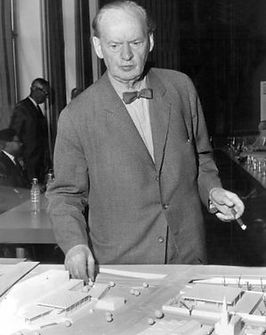
- German architect Hans Scharoun
- Born in 1893 in Berlin , died in 1972 in Berlin .
- He studied at the Technical University in Berlin Architecture ( 1912-1914 ) .
- 1946 Scharoun was appointed professor at the Technical University in Berlin, where he taught until 1958
- He always looks forward to living a harmonious and functional cooperation for building and landscaping .
- He was an important exponent of organic and expressionist architecture.
- The project site IN Lobau , Germany .
- Years of construction: 1930-1933
- Style : Modern .
- The house has a functional organization for a family of 6 persons (parents and 4 children) and the service person.
- The house is divided into 3 levels: basement, ground floor and first floor.
- The house sits on a hill with great views, and take advantage of the views offered by terrain.
- Many of the concepts of modern architecture, such as lifting work on stilts and find different spatial locations and contact home abroad application .
- At this height , and is resolved slope with him, allowing access to the basement, where there is a multi-purpose lake a small space can be overlooking multi them


- site plan :
- plans :
First floor
Second floor


- Master bedroom shared with the rest of the house. Stay behind the visitor access to the guest bedroom above the kitchen area has.
- The completion of the number of bedrooms cabin with master bedroom larger. The center of a double bath.
- Master bedroom has a special status, away from the usual type, and provides the bedroom of marriage as a large open space, which scored some furniture isolated continuous and open space; private sofa reclines in a transparent window.

views


- Perspectives :
B - New York Five :

Peter Eisenman

Michael Graves

Charles Gwathmey

John Hejduk
Richard Meier


1- Peter Eisenman :
- American architect .
- Born in 1932 in New Jersey, United States .
-Aattabr Of the pioneers of deconstructionist architecture .


- In its concept and process, the Wexner Center is an exemplary illustration of Eisenman’s unique approach to architecture. While not entirely disconnected from its context, the building is for the most part a self-realizing and autonomous work,
- Also prominent on the museum are a set of red brick turrets that dramatically clash with the hyper-modern aesthetic of the scaffolding. They are allusions to a medieval-style armory that was bulldozed to make room for the museum, an eerie tribute to construction’s destructive side.
- Wexner Center for the Arts

2 - Michael Graves :
- American architect .
- (July 9, 1934 – March 12, 2015) .
- He was a representative of New Urbanism and New Classical Architecture and formerly designed postmodern buildings, and was recognized as a major influence in all three movements .
- A bright and fun building that stands out against it’s surroundings, Michael Graves is well respected for his design that brought hope to the families of children with disabilities in Washington D.C. and surrounding areas.
- The building also includes a nursing facility, physical therapy centers and a hydrotherapy room. There are studios for art and music, and sensory rooms designed to stimulate students with lights, colors and sounds by the flow of natural light.


- Coletta School :


3- Charles Gwathmey :
- American architect .
- (June 19, 1938 – August 3, 2009) .
- He received the first Yale Alumni Arts Award from the Yale School of Architecture .
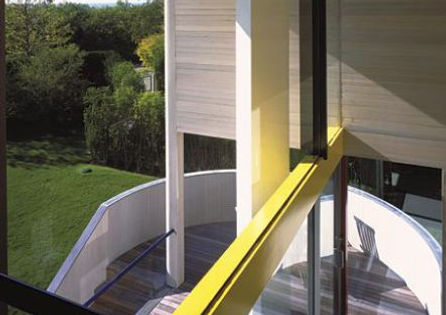


- Casa Gwathmey :
- Are another aspect of this work is the distribution of functional unusual. I say unusual because usually at the home of two or more plants (three in this case) is more privacy, and we climb.
- This is the most intimate spaces are placed in the upper part and plants the general public on the ground floor. Architect decides that the first floor is the public (food, living and kitchen), while the most intimate region is still at the top level.
- In the basement at the same time, we have a guest bedroom, the decision to put the social sphere of the home, should lead to the generation of Gwathmey direct access from the outside at this level.
- Which leads to the outer curved balcony dramas that resolves the external - internal transition.

4- John Hejduk :
- American architect .
- (19 July 1929 – 3 July 2000) .
- Hejduk studied at the Cooper Union School of Art and Architecture, the University of Cincinnati, and the Harvard Graduate School of Design, from which he graduated with a Masters in Architecture in 1953 .


- The house is a study of the relationship between inside and outside and is reminiscent of Corbusian architecture, although a bit more eccentric .
- focus on the more flat dimensions of architectural form as well as the focus on puré volumes.
- Organized around a central axis of horizontal and vertical plane, a three-dimensionality allows for experiencing the spaces.
- Accompanying these, a two-dimensional plane disconnects but at the same time groups the functional spaces which appear separate from one another while emphasizing the poetic nature of the residence.
5- Richard Meier :

- American architect .
- Born October 12, 1934 .
- Affected its Bmsammin other likes Miss Van de Roo, and Frank Lloyd Wright, and Luis Barragan.
- Bodrum Houses :


- A clear promenade sequence will characterize each prototype, with an entry drive leading to an exterior entry stair then into the house’s foyer and on to a double-height living room.
- the fireplace chimney will be the central organizing a living room, dining room, kitchen, and powder room on the ground floor .
- giving them a cubic appearance and connection to the site. The exterior spaces have been of the structures’ volumes while remaining under an overarching roof .
- Wall House 2 :
- Schminke House :
C - Jacques Derrida :
- Jacques Derrida born Jackie Élie Derrida July 15, 1930 – October 9, 2004) was a French philosopher .
- born in Algeria. Derrida is best known for developing a form of semiotic analysis known as deconstruction, which he discussed in numerous texts.
- He is one of the major figures associated with post-structuralism and postmodern philosophy .
- Particularly in his later writings, he frequently addressed ethical and political themes present in his work. These writings influenced various activists and political movements.
- Derrida became a well-known and influential public figure, while his approach to philosophy and the notorious difficulty of his work made him controversia .

bottom of page